
The Stoic Matrix
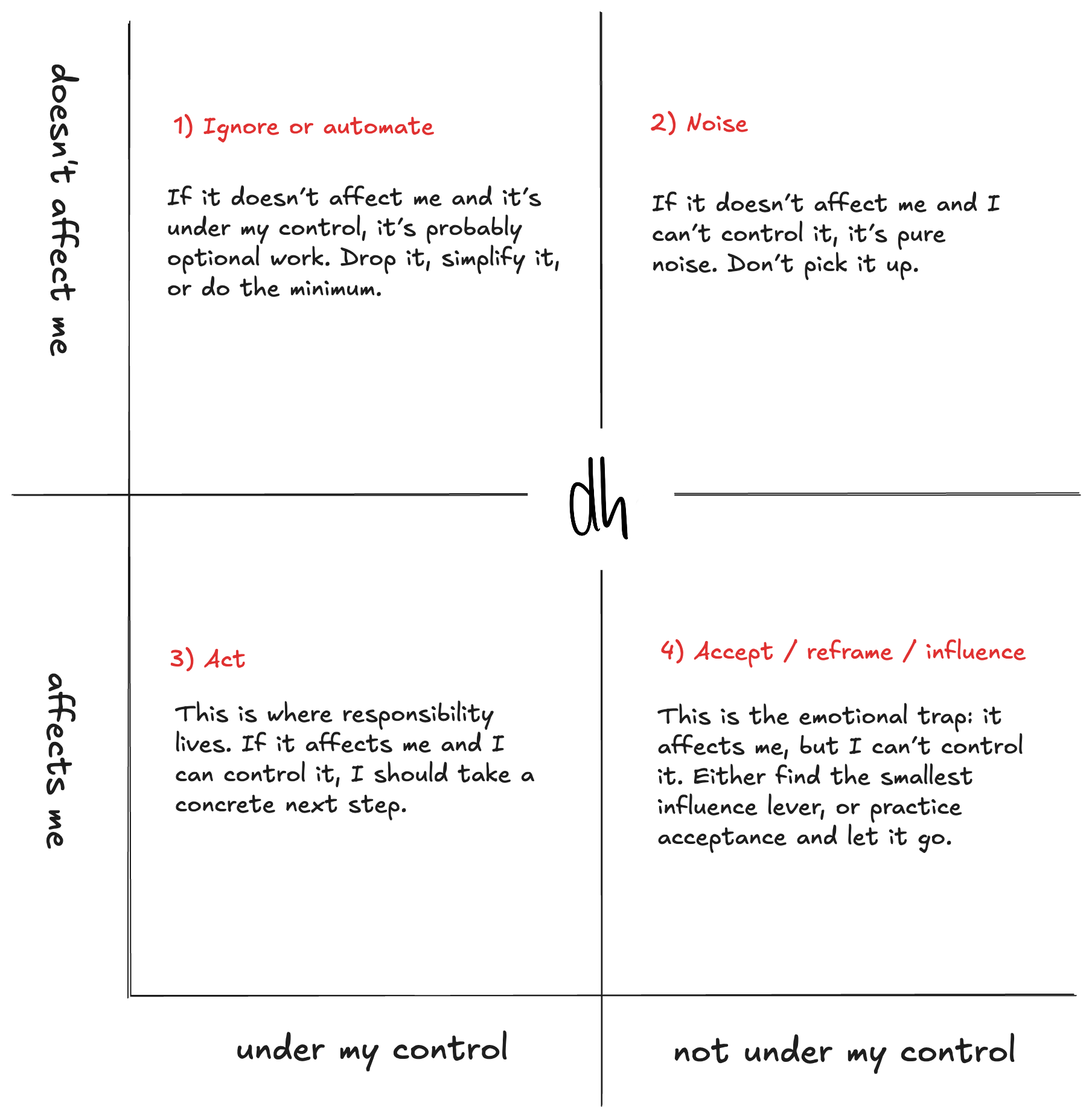
A couple of years ago I built a tool for when I felt overwhelmed and thought I had to save the world again.
It focuses on what you can control and what affects you. It's not a tool to get sh*t done, but a tool to gain clarity on where to spend your time and energy.
The idea is simple. You map what keeps you awake or stresses you on a 2x2 matrix and figure out where you need to act and where to let go.
How it works
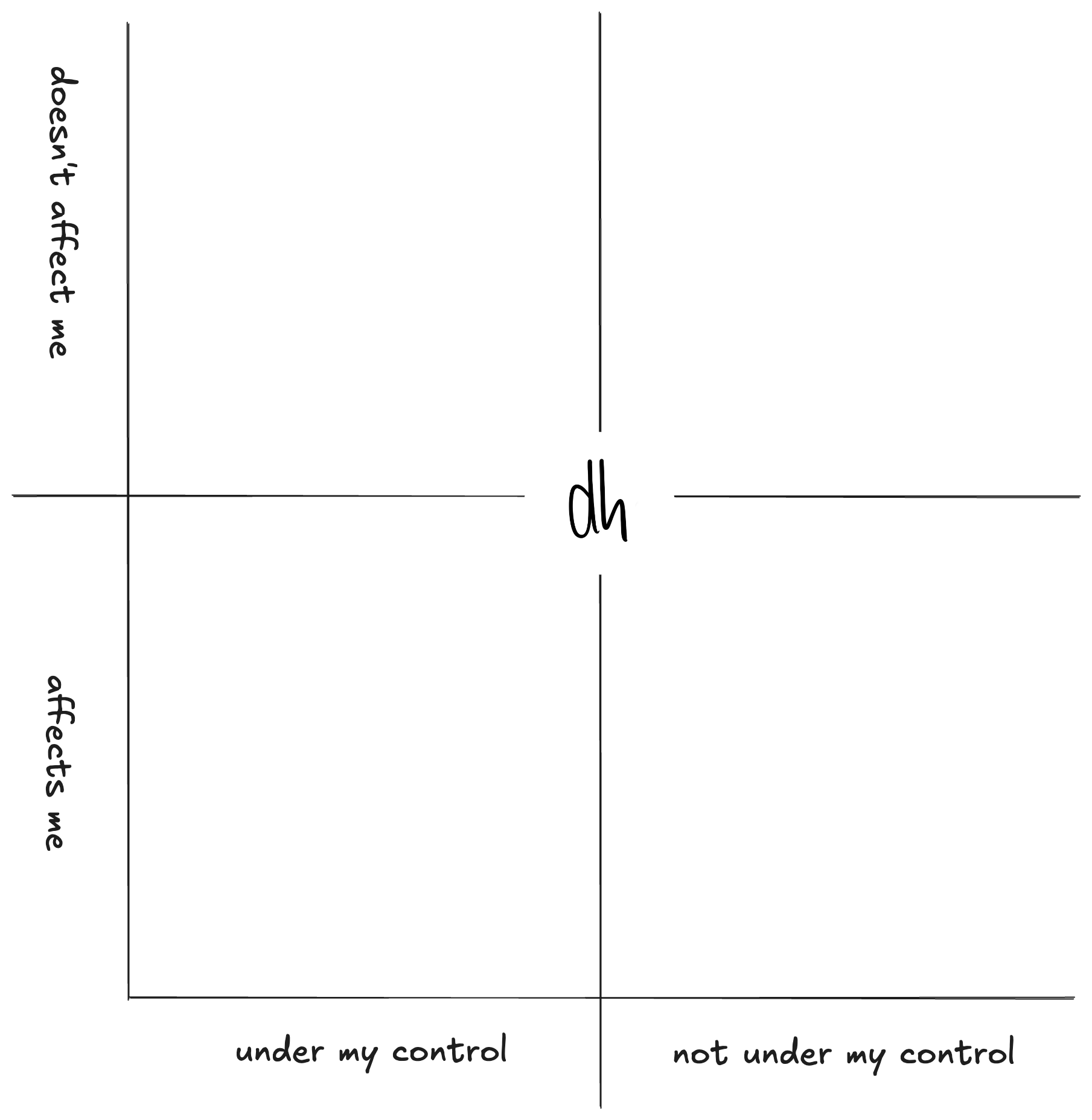
You can draw a simple 2x2 matrix on any (virtual) whiteboard, like below.
Now it's time to let your brain wander.
- What keeps you up at night?
- What is stressing you?
- What are you worried about?
- What are you playing back and forth in your mind?
- What are you working on all day long?
- What is the thing that never seems to get ready?
For everything that comes up ask yourself two questions:
- Can I control it?
- Does it affect me?
If you can control it, and it does affect you, it goes into the lower-left quadrant.
If you can't control it, and it does affect you, lower right.
If you can control it and it doesn't affect, upper left.
If you can't control it, and it doesn't affect you, upper right.
Don't overthink it
This is about gut feelings; don't become too analytical here. If you have to think about whether it affects you, the answer is NO.
It's not an exercise to change your life; it's to help you gain clarity and find your next best action while you are overwhelmed.
Set a timer for 10 minutes and write whatever comes to mind - no need to be perfect here.
What to do with each quadrant
Once you are done filling in the quadrants, it's time to check our options.
Upper right: Doesn’t affect me + Not under my control → Noise
This is where your attention goes to die. What to do:
- Stop consuming it.
- Stop rehearsing it.
- Stop arguing with it in your head.
Ask yourself, is this my business?
Upper left: Doesn’t affect me + Under my control → Ignore / automate
This is the “optional but doable” box. If it’s under your control but it doesn’t affect you, it’s usually:
- busywork
- perfectionism
- habits that made sense once but don’t anymore
What to do:
- Do the minimum viable version, or
- Automate it, or
- Delegate it, or
- Delete it (yes, really)
Ask yourself, if I never did this again, what would actually break?
Lower left: Affects me + Under my control → Act
This is where responsibility lives.
What to do:
- Turn the item into a next physical action.
- Make it small enough you can do it today.
Examples of “next actions”:
- Draft the first paragraph.
- Send the message asking for a decision.
- Block 30 minutes and ship the simplest version.
Ask yourself, what’s the smallest step that moves reality?
Lower right: Affects me + Not under my control → Accept / reframe / influence
This is the emotional trap: it affects you, but you can’t directly control it. This quadrant has only two honest exits:
A) Influence (if a real lever exists)
Influence is not “I could maybe change this if I worry hard enough.”
Influence is: a specific lever you can pull in the real world.
Examples of influence levers:
- Have a direct conversation.
- Make a concrete request (for example: “I need a decision by Friday.”).
- Propose two options and ask the person in control to choose.
- Set a boundary (for example: “I can’t own this, but I can support you with X.”).
- Run a small experiment.
B) Acceptance (if no lever exists)
Acceptance is not liking it. Acceptance is stopping the internal fight.
Practical acceptance can look like:
- Naming reality in one sentence.
- Removing the recurring thought loop by writing it down.
- Choosing where you’ll spend your energy instead.
Ask yourself, if I can’t change this, what do I want to do with the energy I’m burning on it?
Try it right now (5 minutes)
- Draw the 2×2.
- Brain dump 10 items that feel heavy.
- Place them quickly.
- Circle one item in “Act” and take a 10-minute next step.
- Pick one item in “Noise” and consciously drop it for 24 hours.
Closing thoughts
This isn’t a tool to do more. It's a practice to stop you from overthinking and keep your mind busy.
The initial version I've built for my girlfriend, a product owner. So feel free to give it a try regardless of your profession. We all have a lot going on in our minds these days.